Showing posts with label beans. Show all posts

Thursday, March 7, 2013

The Lunch Box


I recently drove up to St. Catharines, Ontario Canada to visit with girlfriends. While there Suzy took us to the Lunch Box. Described as a mom and pop place, the eclectic mix of decor and people were endearing.


The burgers are hand formed, the slab bacon rich and meaty, the hot sauce is housemade.


Lunch Box on Urbanspoon

This was a really great place and the food was just outstanding! If you are ever in the area, check it out.

Saturday, January 26, 2013

Minestrone Soup

Minestrone soup is made with at the very least cabbage, carrots, tomatoes, beans, and pasta. There are as many variations on this soup as there are stars in the sky, but this one is a Levay-Krause family favorite and I hope it will become your family's favorite.


Warm the sliced onions in a bit of olive oil, until they become soft. Add to a large stock pot or crock pot, along with minced garlic, chopped carrots and celery, 4 tbls fresh oregano, thick sliced cabbage, and diced tomatoes.


Brown the meat and add to the pot along with all of it's drippings. Pour in 6 cups of water and then the very well drained beans.


Add in 2 tbls each salt flakes and cracked peppercorns, and 1 tbls ground white pepper. Turn up to medium-high heat, stir well and cover. Twenty minutes before serving, bring water to a boil and cook the pasta until just firm. Drain and toss with a splash of olive oil. Add to the rest of the soup, stir, and then serve with bistro bread.

Wednesday, November 21, 2012

Italian One Pot Supper

Dinners over the last few weeks have been repeats or takeout and I got tired of the same old same old. Here is a take on a one pot supper I had years ago at a little Italian dive in Sligerlands, NY. This recipe uses thick slices of garlic, minced chives, cannellini beans, olive oil, hearty brown rice, slivered brussels sprouts, and organic flank steak massaged with white pepper.


The garlic is sliced thick and then the flat of blade is pressed to release the oils.
The meat is sliced 1/4" thin and then sprinkled with a bit of white pepper and olive oil and massaged for a moment, forcing the oil and seasoning into the meat's fibers. Sprinkle liberally with flake salt.

Make three cups of rice.


In a large wok, fry the garlic, well drained beans, and minced chives in 1/4 cup of olive oil. Stir gently, so the skins do not break, until they begin to crisp and thicken. Add the meat and fold until well cooked.


Then add the brussels sprouts, folding until cooked. Serve over rice and a glass of Australian Hunter Valley Sémillon.

Saturday, September 22, 2012

Jerk Ribs and Jamaican Coat of Arms


At the last IN event, Chef Krista won the evening's competition with her Jamaican Hot Sauce. She gave me a bottle of her new Jamaican Hot Sauce. She warned me that this was an error bottle, twice the chillies had been added when it was made. New bottles were being produced but she handed a few of these out. I love hot sauce and figured a batch of coat of arms would be perfect to try this "error" sauce on.

I totally underestimated how hot this hot sauce would get!

My eyes, nose, and upper lip were on fire. It so delicious!


I used some of her jerk sauce to marinate a rack of organic ribs and grilled them. They were served up with lightly steamed broccoli and a pile of coats of arms and a tall glass of Flying Bison's Buffalo Lager.


2 (16 ounce) cans coconut milk
2 cups white rice
1 onion, finely chopped
1 garlic clove, minced
32 ounces canned black-eyed peas
1/4 teaspoon allspice

In a medium saucepan, combine the black eyed peas with the allspice and simmer on low heat. In another medium saucepan, combine the coconut milk, rice, onion and garlic. Bring to a boil over high heat and stir. Reduce heat to low, cover and cook for 30 minutes, or until all of the liquid has absorbed. When the rice is done, remove the black-eyed peas from the heat. Rinse and drain them very well and mix in with the rice. Serve hot.

Monday, May 28, 2012

Green Chilies Enchiladas

Fry very skinny strips of chicken, beef, fish or vegetables in a bit of salt and pepper and a splash of olive oil until slightly browned.


Boil 1 lb of tomatillos in 4 cups of water until soft, about 5 min. allow to cool then add cooked tomatillos and 2 cups of the cooking liquid to a blender. Then add 4 cloves of garlic, ½ bunch of cilantro, ½ a large yellow onion, ½ of a jalapeno (no seeds or veins, more or less can be added) 1 tsp each of salt and sugar. Blend on high until smooth. Heat a large frying pan with 2 tbls of sunflower seed oil, add the sauce to the frying pan and simmer for 5-10 minutes.
Shred cheese and set aside. This is Monterey Jack.
Pre-heat the oven to 400 degrees. Lay out the tortilla and layer in your filling and cheese and roll very tightly.
Once they are all rolled and laid tight against one another, pour the green chilies sauce on top. Use your fingers to spread the sauce over every tortilla evenly. Then sprinkle a little bit of cheese over the top. Bake for 30 minutes.
 While the enchiladas are baking make refried beans. I love cannelloni. These are pan fried in a little bit of olive oil, salt and pepper.


Serve with salad and the beans and enjoy!

Monday, May 14, 2012

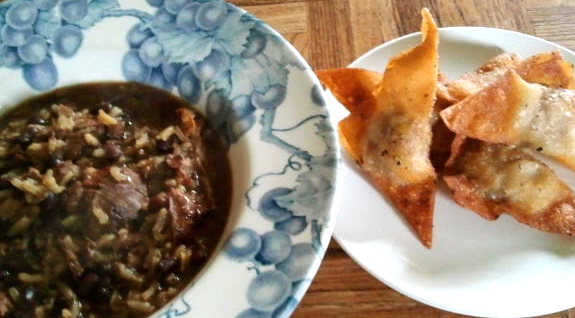
Shāndōng zhōngguó wǎncān (Chinese Supper) - Pork Dumplings and Braised Pork and Black Bean Soup

 Pork sausage, minced onion and powdered garlic.

One teaspoon per wrap. Dampen two edges and press together well.
Pile and have near the pre-heated oil but far enough so they stay cool and don't stick together.
Only fry four at a time.
 The pork ribs were coated in hoisin sauce and slow cooked in a crock pot for ten hours. The bones were pulled and water, black beans, organic fermented bean vinegar and dried plums were added. Rice was added a half hour before serving.
Zhū ròu shuǐjiǎo.
Hóngshāo zhū ròu hé hēidòu tāng zhōnggu.

Thursday, May 3, 2012

May Garden Updates

On May 1st, Beltaine, my family came out to the garden to help plant some of the beans and to pop off the frost covers. Those covers protected all of our plants but one of the Silver Thyme, which may or may not make it. We'll know for certain if it survived in another week. The potatoes popped up and showed their dark leaves, straining through the straw. Notice how purple these leaves look?
 The Black Beans went in, in two neat rows along one edge of the trellis. The plan is to feed them onto the trellis and have a "fence" of beautiful beans. The leaves will be lush, the flowers delicate and sweet, and the bean pods will number in the hundreds.
 Here is another shot of some of the Purple potato leaves. I can nearly taste the creamy fingerling potatoes now!
These petite sage bushes will quintuple in size to roughly 1 x 1 foot square by the end of the growing season. Their leaves will intermingle as they grow, offering protection from wind and heavy rains and preventing weeds from growing between them.

I received these garlic as a gift from Singer Farm Naturals when I went to Burchfield Penny Art Gallery's 2nd Friday event on April 13th. I cut them to add to a beef casserole and they've been growing steadily ever since.
Today I went to the garden in the early morning fog, after dropping the girls off at school. The Kidney and Pinto beans went in like sleepy babies. All droopy headed.
The Pinto beans were the hardest to start and I'm not even certain if these two will actually produce anything, but I'm giving them a chance to show off and prove me wrong.
 Here the nineteen plants sit in their nice neat rows. In a few more weeks they'll be growing pell mell up the trellis.
 It's only been a couple of days since I saw these last and look how much they've sprouted!
I have ten more plants to put in this week. These little ones look so lonely holding the corner on their own.

Wednesday, April 4, 2012

Planting Beans

Growing beans may seem challenging at first, during the sprouting phase, but growing beans once the sprouts are planted in the ground is quite easy.
Good preparation and early care will lead to a rewarding bounty of bushels and bushels of beans!
Beans prefer warm weather and should not be planted until the frosts are well past. They should be grown in spots that receive full sun in well drained, fluffy, fertilized soil. Preparing the soil with compost and manure before planting is highly recommended. Beans come in numerous varieties consisting of both bush and pole types. Deciding what variety of bean you want to grow and whether to grow the bush or pole type plant is important when you are planning your garden.
Green beans are probably the most widely grown in the vegetable garden. They adapt quite well to a variety of soil types, provided the location is in an area with good drainage. They are also available in both bush and pole types. When harvesting green beans, pick them once they have reached adequate size but do not allow them to over ripen. When they are too ripe, the pod becomes tough, and the bean will taste bitter.
Yellow beans only come in the bush variety. They are quite similar to green beans in all aspects with exception to taste and tenderness. Lima beans, or butter beans,

come in both bush or pole varieties. These beans are flat and rounded with a very distinct flavor.
Lima beans should be planted a week or two later than other garden beans. Navy beans, Black-eyed peas, or cowpeas, are popular and easy to grow. Peas are highly nutritious, tasty, and easily grown.

Peas are more preferable in cool weather climates and should be planted early. Most beans combine well with other crops that are grown in the garden. Consider growing a Three Sister Garden.
Beans will grow nearly anywhere. These types of beans require staking with supports such as bamboo, string, a fence, trellis, or ladder. Sunflowers or corn stalks can also be used for bean supports. Pole beans can be planted in hills or rows.
Before you plant, however, it helps to incorporate the staking support of your choosing for the beans to climb on once they have reached adequate size.
Growing pole beans gives you the advantage of maximizing your space, and the beans grow straighter and are easier to pick. Beans need adequate moisture;
water bean plants about once a week or more frequently during dry weather. The use of organic mulches, such as straw, grass clippings, or composted leaves will help to retain moisture and control weeds.
Beans are susceptible to a variety of insects with beetles being the most common; these insects can easily be picked off by hand or sprayed with soapy water.


Excessive heat and humidity can cause a variety of disease problems in beans. The more common of these diseases are bacterial or wilt diseases, but there are numerous varieties of beans available that are disease tolerant. To make these newspaper bean boxes visit No Ordinary Homestead.